
Scanning My Bristol Negs
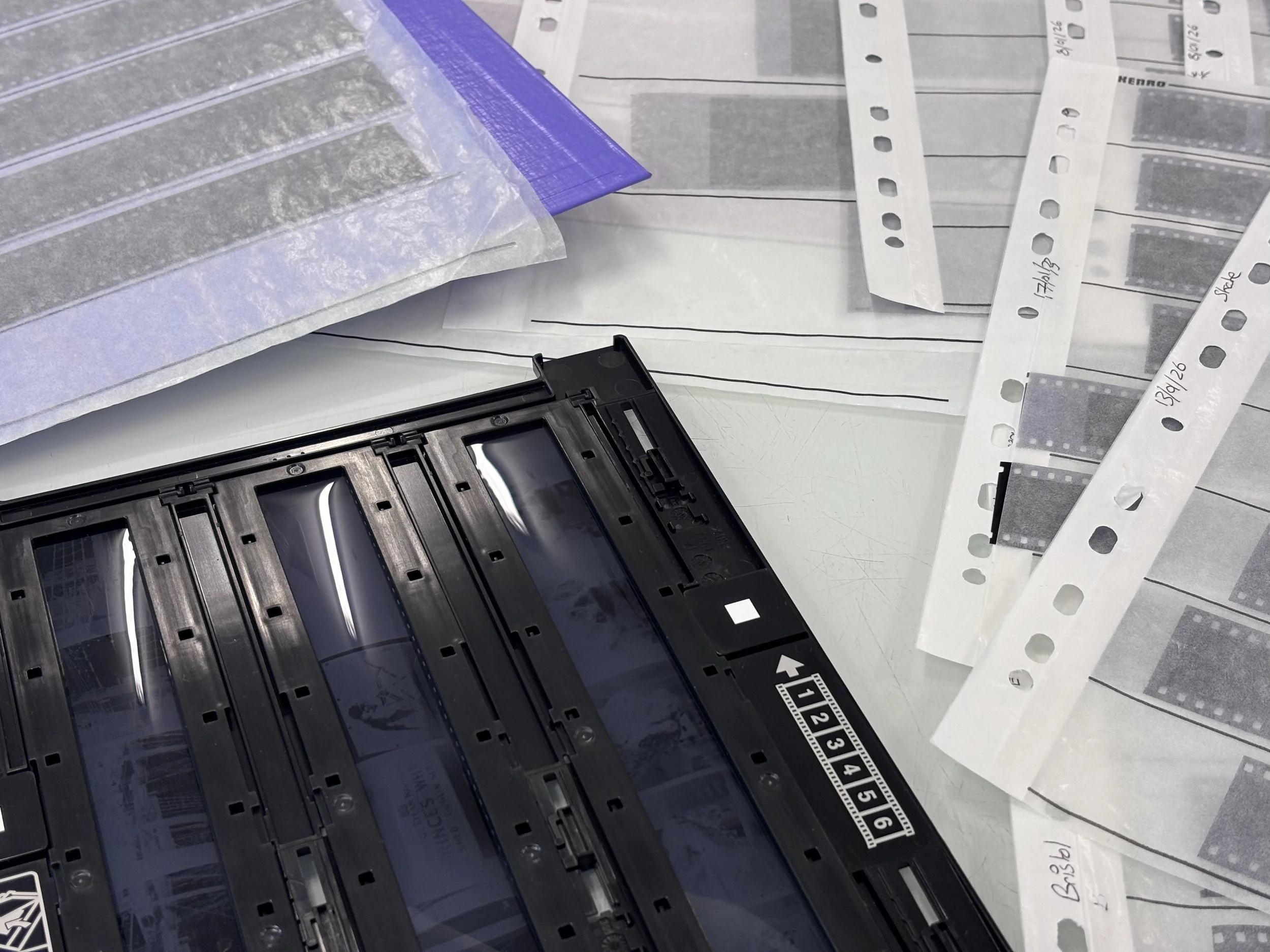
It’s not all negative. Scanning negatives at Creative Spark.
Scanning my Bristol negatives
Today I began the slow, meditative task of scanning my negatives — the ones I developed during my two‑week darkroom residency at the Bristol Folkhouse supported by Cavan Arts. At Creative Spark, I have access to a beautiful archival‑quality scanner, which means I can finally see, in pixels, the images I’ve been holding in my mind since returning from Bristol.
There’s something quietly conflicted about it. I absolutely love the slowness and patience required by analogue photography — the smell of chemistry, the repetition, the tactile rhythms of the darkroom. Sitting now, waiting for a digital screen to populate with pixels, feels almost sacrilegious. But it’s a necessary step for what comes next.
There are around 400 negatives to scan. Four hundred images on film, made over the span of just two weeks. To put that in perspective, I could easily fill a digital memory card with 400 images during a single rugby match. It’s a reminder of how analogue photography slows everything down — how every frame, every exposure, demands attention and care.
My usual practice is a hybrid of digital and analogue, but during my Bristol residency I worked purely with film. I made contact sheets from the negatives, selected my prints, then turned those into a small zine — Cheers, Skate — which I photocopied and hand‑stitched. Only twenty copies exist, and I never made a digital version. The only trace I have are the original, collage‑like pages with the prints still stuck in place, ready for photocopying.
Alongside Cheers, Skate, I also experimented with alternative and natural photo chemistry — using oats, wood ash and coffee grounds. Each ingredient left its own subtle mark. Those variations, drawn from place, make the work feel deeply connected to the city itself.
The scanning process might feel like a necessary evil, but as I watch each image reappear on screen, I’m reminded that it’s just another way of revisiting those weeks — translating the alchemy of the darkroom into a different form of memory.
I’ll be carrying those ideas forward into my upcoming workshops with the Photo Museum Ireland in Dublin, where I’ll be sharing some of these analogue and experimental techniques. The sessions will run on Saturday 28th Feb (Soil Chromatography), Sunday 22nd March (Lumen Prints & Botanical Film Developing) and Saturday 11th April (Lumen Prints & Caffenol Film developing).
If you’d like to follow this project as it evolves — or hear about future workshops, zines, and exhibitions — you can join my mailing list. I share updates there first, along with occasional glimpses into my process, darkroom experiments, and new work in progress.